

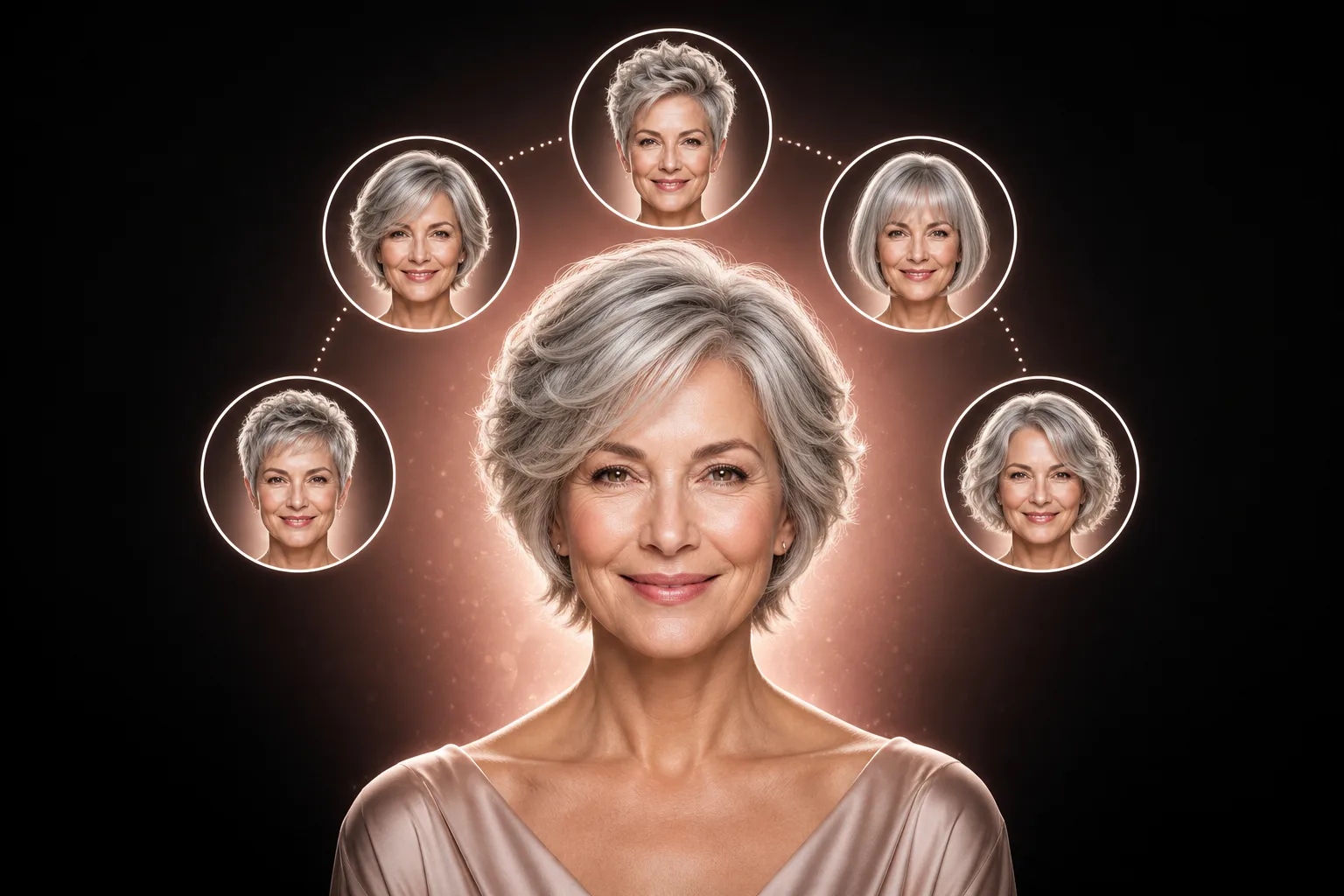
Short Hairstyles for Women Over 50, on Your Own Face
Upload one selfie and see a pixie, a bob, or a crop on your own face, not a model's, in about 10 seconds. Your hair has changed since you last went short: density, texture, maybe color. The cuts below are picked for that, and you can check each one on your photo before your stylist touches a pair of scissors.
What Actually Changes About Short Hair After 50
Density, mostly
Most women's hair carries less density at 50 than it did at 25. That's not a flaw to hide, it's an input the cut has to work with. A cut that relied on sheer volume back then can read thin now; a cut built around layers close to the face reads full at any density.
The same pixie sits differently
Skin, jawline, and hair texture all move together over decades. A pixie you wore at 30 will frame your face differently now, not worse, differently. That's exactly why a photo of you, today, tells you more than a photo of anyone else at any age.
Morning time, back
A well-cut pixie air-dries in five minutes. A layered bob needs less product and fewer tools than long hair ever did. If your mornings are the actual reason you're considering this, that reason is legitimate on its own.
Gray is a choice, not a default
Plenty of women pair short hair with letting color go, plenty keep it. Neither is the "right" move at any age. If you're weighing gray specifically, the tool renders that too; full breakdown at see myself with gray hair.
Fine or Thinning Hair: The Cuts Built for Less Density
Seven of our short women's cuts are hand-picked for fine or thinning hair, meaning the shape holds without relying on volume you don't have. In the app, the Layered Bob and the Bixie are the two people try most from this list.
| Cut | Why it holds on fine hair | Best face shapes | Trim cycle |
|---|---|---|---|
| Blunt Bob | Layers land close to the face, adding visual weight where it shows | Oval, Heart, Diamond | ~6 wks |
| Layered Bob | Layers land close to the face, adding visual weight where it shows | Square, Rectangle, Diamond | ~6 wks |
| A-Line Bob | Layers land close to the face, adding visual weight where it shows | Oval, Round, Heart | ~5 wks |
| Classic Pixie | Short length concentrates density instead of stretching it | Oval, Heart | ~4 wks |
| Textured Pixie | Short length concentrates density instead of stretching it | Oval, Heart, Square | ~5 wks |
| Bixie | Short length concentrates density instead of stretching it | Oval, Heart, Diamond | ~6 wks |
| Undercut Pixie | Short length concentrates density instead of stretching it | Round, Oval, Diamond | ~3 wks |
What to avoid on fine hair: long, blunt, one-length cuts. They look full in a photo of thick hair and flat on hair with less density, because there's no layer break to catch light or movement. If your stylist suggests "just a trim," that's often the wrong call for thinning hair; a shape change usually reads fuller than the same length kept longer.
Over 50 or Over 60: Different Advice, Same Tool
Editorial advice tends to split by decade, and there's some real signal in that split, even if it doesn't apply to everyone the same way:
In your 50s
Often still coloring, often less ready for a drastic change, so a bob (blunt, layered, or a-line) is the common first move, softer than a pixie and easier to grow out if you change your mind.
In your 60s and beyond
More often past the coloring question and prioritizing low daily effort, which is where the pixie family (classic, textured, undercut) tends to win: a few minutes to dry, a trim every 4-5 weeks, done.
Neither lane is a rule. Some women in their 70s want the bolder pixie and some in their 50s want the lowest-maintenance cut they can get. The render doesn't know your age, only your face, your hair, and the cut you point it at, which is the honest way to settle it.
Short Hair and Glasses
Frames sit right at eye level and add real visual weight there. Short hair with volume at the crown (a textured pixie, a layered bob) balances that weight instead of competing with it. Hair that goes flat on top, or a fringe that lands on the brow line of the frame, tends to fight with glasses rather than frame them. If your glasses are part of your daily look, upload a selfie wearing them; the render keeps them on. Frame-shape specifics live at hairstyles for glasses.
The Cuts to Try First
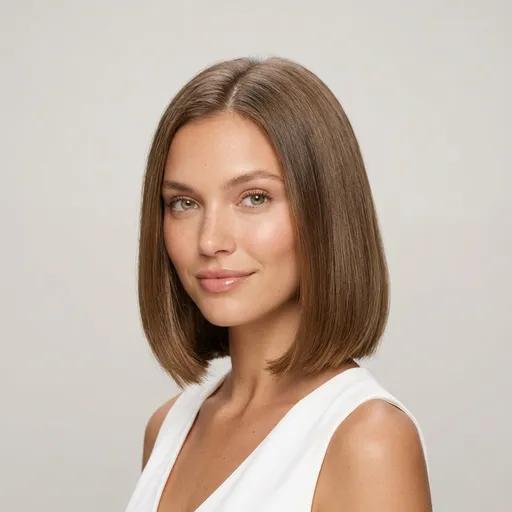
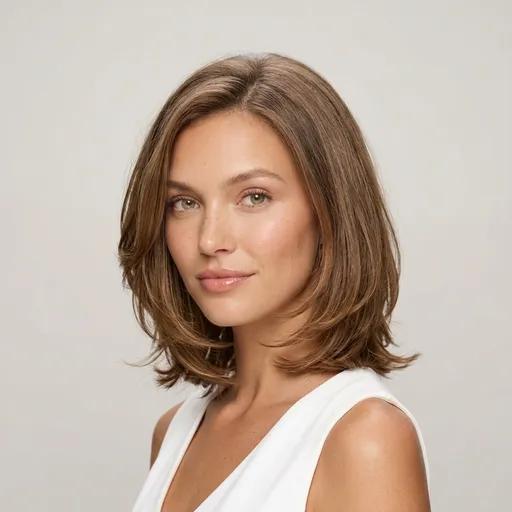
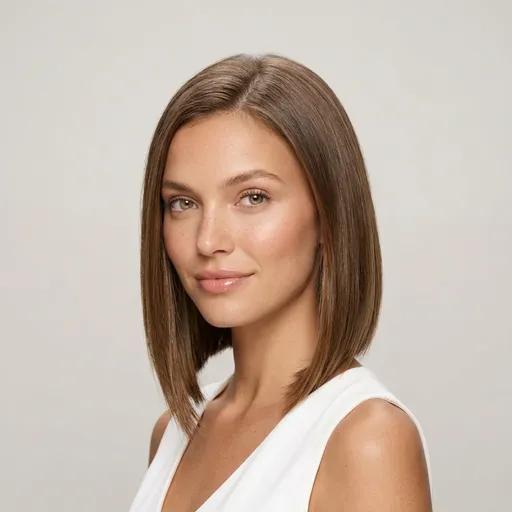
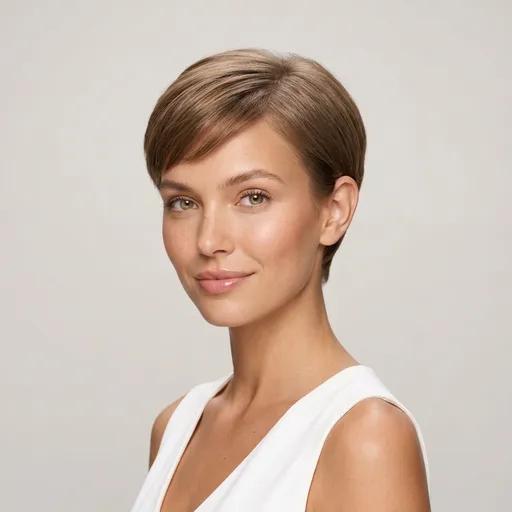
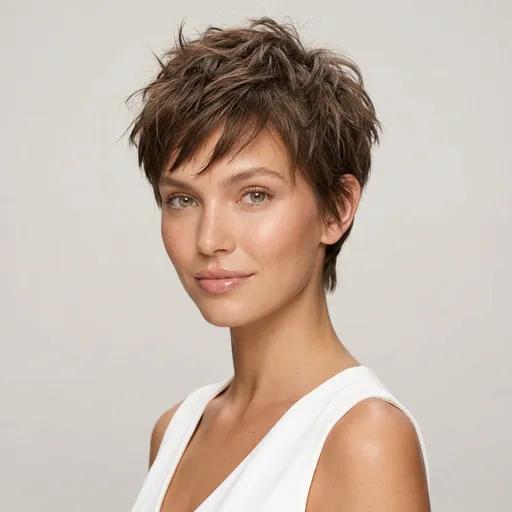
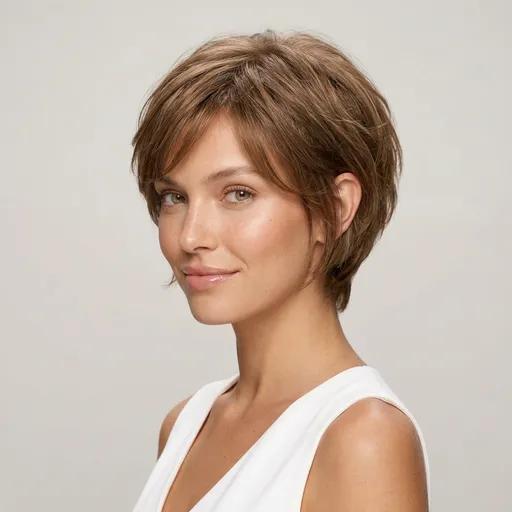
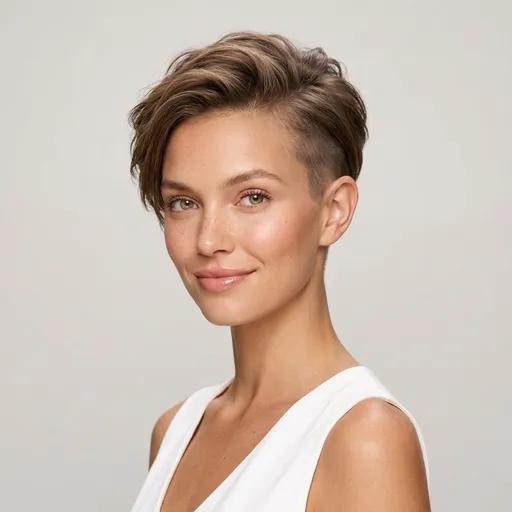
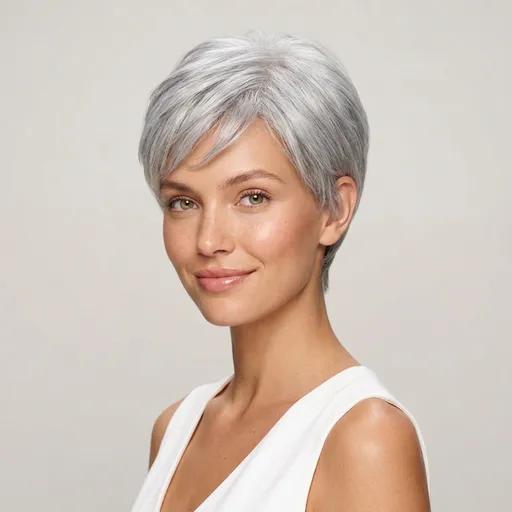
These eight are the fastest way in. The full women's catalog, 23 short styles among it, is browsable at all hairstyles, and everything above renders on your own photo the moment you upload one.
Not sure a pixie or a bob is even the right lane? A face-shape analysis narrows it before you look at any specific cut. Upload one selfie to the see which hairstyle suits you with AI and get your 4 best matches in about 30 seconds — free.
From Photo to Chair: What to Actually Ask For
Show the render first, it says more than any description. Then be specific about the one thing photos don't capture: how the cutting technique itself affects fine hair.
A-Line Bob
"A-line bob, shorter in the back and angling longer toward my chin. Point-cut the ends so it doesn’t read blunt. I want it to move, not sit flat."
Textured Pixie
"Textured pixie with more length left on top than you’d normally take. Point-cut for texture, not thinning shears, they’ll make fine hair look sparser."
Layered Bob
"Jaw-length bob with internal layers starting at the cheekbone, not the crown. I want lift at the root, not thinned-out ends."
Undercut Pixie
"Cropped pixie with a visible undercut at the nape. Keep the top with enough length to style forward or back, so it’s not one fixed look."
Frequently Asked Questions
Is there an app to try short hairstyles for women over 50?
Yes. HaircutAI renders short cuts on your own selfie: pixies, bobs, and crops, gray or your current color, in about 10 seconds. It runs in the browser at haircutai.app and as a free iOS app. You're not browsing a stock photo gallery of other women; you're looking at your own face with the cut on it. Free to start; the full catalog at high resolution is part of the paid plan.
What's the best short haircut for fine or thinning hair after 50?
Cuts that put weight and layers close to the face read fuller on fine hair than cuts that leave long, thin-looking ends. A-line bobs, textured pixies, and undercut pixies are built for this: the shorter length concentrates whatever density you have instead of stretching it thin. Blunt, one-length cuts do the opposite; they show through at the roots on fine hair. See the table above for the specific picks and their upkeep.
Does a short haircut suit any age?
Yes, no face shape or age is excluded from short hair. What changes over time is density, texture, and how much daily styling you want to do, and a good cut is chosen around those things, not around a birthday. The honest way to know if a specific cut suits you is to see it on your own face, which is what the tool on this page does in one photo.
How do I choose between a pixie and a bob after 50?
A pixie is the fuller commitment: it exposes your whole jawline and neck, dries in minutes, and needs a trim every 4-5 weeks to hold its shape. A bob keeps more length around the face, grows out more gracefully, and still shortens your styling time versus long hair. If you're unsure which framing you'll like, render both on the same photo before you decide; the difference is easier to see than to imagine.
Can I see how gray or silver hair would look with a short cut?
Yes. The tool renders color changes the same way it renders cuts, so you can preview a silver pixie or see your current cut with a natural gray grow-out before committing to either. The dedicated breakdown of gray, silver, and salt-and-pepper options, including what each actually costs to maintain, is at see myself with gray hair.
Do glasses limit which short haircuts work?
They change what looks balanced more than they limit anything. Frames add visual weight at eye level, so cuts with volume at the crown (a pixie, a layered bob) balance that better than styles that go flat on top. Heavy fringe that lands on the frame's brow line usually fights with it. The full breakdown of frame shapes and cuts is at hairstyles for glasses.
How is this different from a hairstyle photo gallery for over 50?
A gallery shows the cut on someone else, usually a model decades younger with different density, texture, and bone structure than you. This tool shows the cut on your own photo: your hairline, your face shape, your current color. It answers 'would this work on me' instead of 'does this look good in general', which is the question that actually matters before a cut you can't easily undo.
How long does a pixie or bob take to grow out if I don't like it?
A layered bob grows back to shoulder length in under a year. A pixie takes longer, roughly 18-24 months to reach a bob, with an awkward in-between stretch most women manage with a soft, low-maintenance shape rather than fighting it. Neither is permanent; both are slower to undo than to try on a photo first, which is the entire case for previewing before you book.
See It on You Before You Book It
One selfie, under a minute, your own face wearing the cut. If it's not right, you'll know before the scissors do.